Stargazing for Beginners: Tips from Your Glamping Chair
Your Glamping Chair: The Coziest Astronomy Deck You'll Ever Use
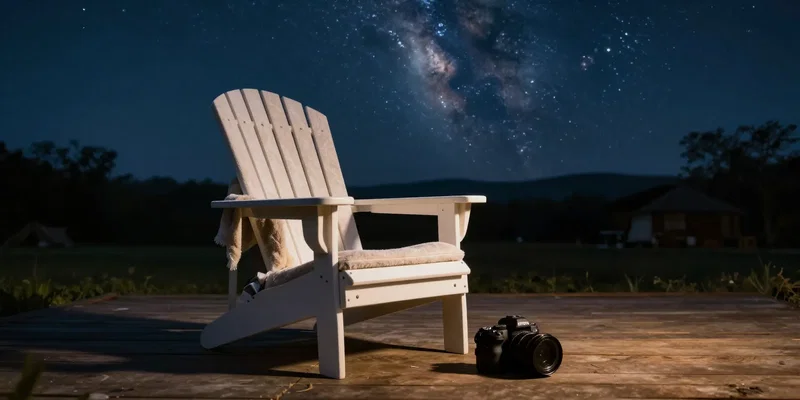
Let's be honest, most stargazing guides start with you lying on the cold, damp ground. No thanks. That’s where your glamping setup is an absolute advantage. That fancy, ergonomic chair isn't just for Instagram. It's your zero-gravity cockpit for the cosmos. It keeps you elevated, dry, and still. The number one rookie mistake? Craning your neck and fidgeting. Get comfy. Lean back. Let the chair hold you. Your only job now is to look up.
Ditch the City Lights and Let Your Eyes Do the Heavy Lifting
Here's the thing about your eyes: they're lazy in the light. It takes them a solid 20 minutes to fully switch into night-vision mode. That light from your phone screen? It just reset the clock. Sit down, get settled, and turn off every single artificial light. Your phone. The lantern. The cute fairy lights on the tent. Sit in the dark and just breathe for ten minutes. You'll be shocked. Stars will start popping out of the blackness you thought was empty. Patience isn't a virtue here; it's the main tool.
Forget the Telescope. Seriously, Start with Binoculars.
Everyone wants to jump straight to a giant telescope. It's a rookie trap. Tougher to use than you think, and they magnify every tiny shake from your hands. Your best first piece of gear is already in your camping kit: a pair of decent binoculars. 7x50 or 10x50 are perfect. They're easy. Just point at the sky and suddenly, the blurry patch of the Milky Way resolves into a field of a thousand tiny diamonds. You'll see Jupiter's moons as little dots. A whole new layer of the sky opens up. All from the stability of your chair's armrest.
Don't Download an App. Learn One Constellation.
Star apps are amazing. They're also a crutch. You'll spend the whole night staring at your screen, not the sky. Try this instead: before you go, learn to find just ONE thing. Orion's Belt is the classic cheat code. Three bright stars in a short, straight line. Find that, and you've got an anchor. You can find his shoulders and knees. From there, you can hop to the star Sirius, or up to the red giant, Aldebaran. It feels like magic. It's not. It's just knowing one simple pattern. That sense of personal discovery beats an app telling you what you're looking at every time.
The Real Secret? Just Show Up and Look.
We get so obsessed with gear and perfect conditions. Was that a satellite or a plane? Is that a planet? Who cares. The goal isn't to pass an astronomy exam. The goal is to feel small in a wonderful way. To sit in a comfortable chair, under a blanket, and watch the ancient clockwork of the universe turn above you. Sometimes you'll see a meteor scratch the darkness. Sometimes you'll just sit with your thoughts. Both are a win. The sky doesn't need your understanding. It just asks for your attention. So give it. That's the whole tip.